Why Your Bathroom Mirror Still Has Streaks After Cleaning

Find out why a bathroom mirror streaks after cleaning and follow gentle checks for cleaner residue, hard-water spots, and possible mirror backing damage.
A refrigerator door seal can feel warm even when it is working normally. Many models route heat through the cabinet edge or center divider to limit exterior condensation. A seal that no longer grips, however, deserves a separate check: crumbs or sticky residue, a blocked or misaligned door, or a warped or torn gasket can leave a gap. Judge the result by whether the door closes evenly, the seal holds a simple paper test around its perimeter, and the inside stays at a safe temperature—not by touch alone.
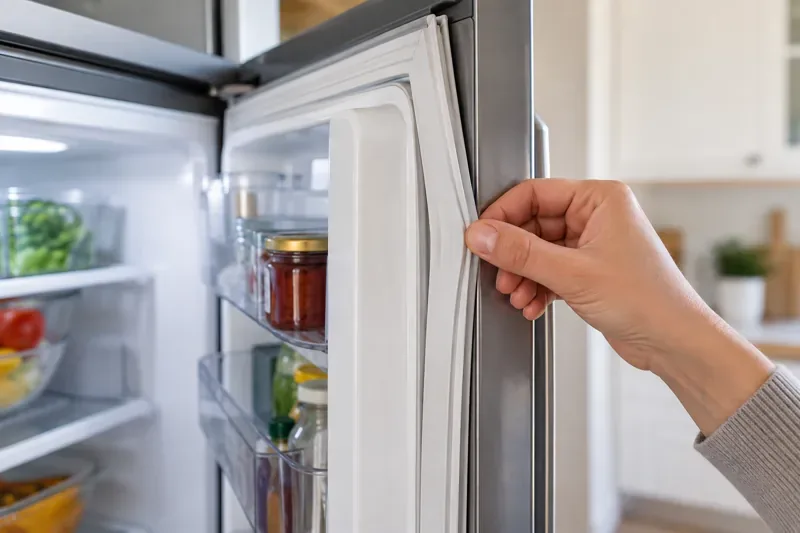
Refrigerators move heat from inside the compartments to the room. On many models, condenser tubing or a heat loop also runs near the front frame, around the gasket area, or through the divider between doors. This helps reduce moisture and frost on the exterior. As a result, the cabinet edge or mullion (the center divider between doors) may feel warm while the refrigerator is cooling normally. Some models also use a heater in a hinged door divider.
Warmth may become more noticeable after installation, after loading a lot of groceries, during frequent door opening, or in a hot kitchen, because the cooling system may run longer. The exact location and temperature vary by design, so compare with the owner’s manual for your model. Whirlpool explains that warmth around the cabinet and gasket frame can come from a heat loop; its condensation guidance also describes a heater in some vertical door seals.
Warmth alone does not prove that the rubber gasket is failing. If the cabinet is unusually hot over a broad area, the refrigerator is not cooling properly, or warmth persists alongside other performance problems, consult the model manual or arrange service rather than trying to diagnose the sealed cooling system by touch.
Look for a pattern of evidence. A door that springs open, needs unusual pressure to stay shut, or leaves one corner visibly separated may not be sealing evenly. Food packaging or frost along the inside edge, repeated condensation near a gap, and a refrigerator that struggles to hold temperature are additional clues. Humidity and frequent door openings can also cause short-lived condensation, so one damp spot is not conclusive.
Inspect the gasket in good light. Look for tears, cracks, flattened sections, folds, sticky residue, or a portion that has pulled out of its retaining channel. A magnetic gasket is designed to contact the cabinet evenly; GE Appliances describes its side-by-side gaskets as magnetic seals that sit in a retaining groove. Visible damage or a section that will not stay in place is a reason to check your model’s parts and service guidance.
Try a paper test at several points around the door. Put a strip of paper halfway across the gasket, close the door, then pull gently. Some resistance suggests contact at that spot; if the strip slides out freely, clean the area and repeat. Check the top, bottom, hinge side, handle side, and corners. One test point cannot establish that the entire gasket seals, and the feel may differ by model. Samsung recommends this test and notes that door alignment can affect the result.
Then check the inside temperature with an appliance thermometer. The U.S. Food and Drug Administration recommends keeping the refrigerator at 40°F or below. A normal-feeling seal does not guarantee safe cooling, and a warm cabinet edge does not by itself mean food is warming. If the thermometer shows the compartment is above 40°F and it stays there after you confirm the setting and close the door, contact the manufacturer or a qualified technician and handle perishable food cautiously. See the FDA’s refrigerator thermometer guidance.
Check that containers, produce drawers, shelves, and door bins are fully seated and not protruding. A bag caught at the edge or a crowded shelf can keep the door from closing even when the gasket is undamaged. Close the door and look all the way around to see whether the gap is uniform.
Wipe the flexible seal and the surface it touches with a soft cloth and mild dish soap diluted in water. Remove crumbs and sticky residue from folds, then dry the gasket. Avoid abrasive pads, sharp tools, and strong solvents that can damage rubber or plastic. Follow your appliance manual for any model-specific cleaner or conditioning instructions; recommendations can vary by manufacturer.
If a small section has slipped out of its channel, consult the manual before pressing it back into place. Do not pull hard or use a tool to reshape it. Check whether the refrigerator is stable and the doors line up; an out-of-level cabinet or a door that was recently removed and reinstalled can interfere with closure. Leveling and hinge adjustment steps differ by model, so use its instructions rather than turning adjustment screws at random.
After cleaning or clearing an obstruction, close the door and repeat the paper test around the perimeter. Observe whether the door stays shut without being pushed and whether condensation or frost returns at the same location. Give the refrigerator time to stabilize after changing a temperature setting, following the owner’s manual. Record the interior temperature rather than relying on how cold the shelves feel.
Arrange service or order a model-correct replacement if the gasket is split, brittle, badly deformed, repeatedly detaches, or still fails the paper test at the same spots after cleaning and correcting obvious obstructions. If the door is sagging or misaligned, a hinge or leveling issue may need attention instead of a new seal. Use the refrigerator’s model number to identify the correct part; gaskets are not necessarily interchangeable even when they look similar.
Seek help sooner if the door will not stay closed, frost builds up quickly near the edge, an alarm or error appears, or the inside temperature remains above 40°F. The seal test is a useful screening check, not a pressure measurement or a repair diagnosis. A warm frame may be normal, but reliable closure and a steady safe interior temperature are the outcomes that matter.
For model-specific examples, review Samsung’s seal and temperature checks, Samsung’s door-closure troubleshooting, and GE Appliances’ gasket adjustment information. These instructions can differ by refrigerator type and model; use your own manual where its directions are more specific.
Find out why a bathroom mirror streaks after cleaning and follow gentle checks for cleaner residue, hard-water spots, and possible mirror backing damage.
Compare small-entryway storage by floor space, capacity, rental limits, and daily use. Keep shoes, coats, and keys organized without blocking the door.
A warm refrigerator door frame can be normal, while poor gasket grip may signal dirt, obstruction, misalignment, or damage. Learn what to check.
Keep stored clothes dry, fresh, and pest-resistant without mothballs by controlling humidity, cleaning garments, choosing the right container, and checking storage regularly.
Learn why indoor plant leaves turn brown at the edges, how to compare watering, light, humidity, fertilizer, and water quality, and what to check first.
Use this family-friendly balcony checklist to decide what to bring indoors, cover, keep outside, or let go before the first frost in a small space.