Why Your Bathroom Mirror Still Has Streaks After Cleaning

Find out why a bathroom mirror streaks after cleaning and follow gentle checks for cleaner residue, hard-water spots, and possible mirror backing damage.
Humidity can damage stored clothing even when there are no moths in sight. Damp air encourages musty odors, mold growth, corrosion on metal fasteners, and conditions that favor some household pests. The most reliable alternative to mothballs is not another strong-smelling product: it is a storage system that keeps clothes clean, fully dry, protected from insects, and held in a space with controlled moisture.
For a beginner, the job is easiest when you separate it into four tasks: prepare the clothes, control the room, choose the right enclosure, and inspect the contents periodically. That approach also avoids a common mistake—treating mothballs as if they were moisture absorbers. They are pesticides, not dehumidifiers. The National Pesticide Information Center says mothballs should be used only according to their pesticide label and, when used for clothes moth control, only in airtight containers where the vapor can reach the required concentration. You do not need them simply to keep seasonal clothes dry.
Relative humidity (RH) is the amount of water vapor in the air compared with the maximum the air could hold at the same temperature. High RH means fabrics can stay damp for longer, especially in closed closets, basements, exterior-wall cabinets, and poorly ventilated rooms.
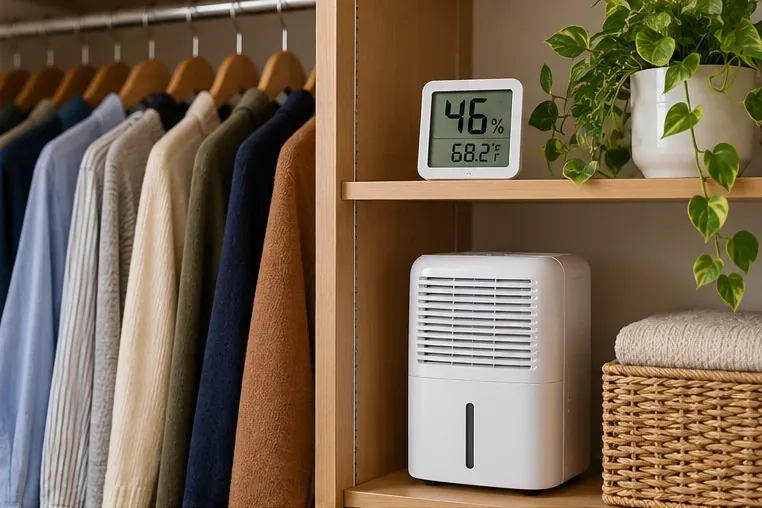
The U.S. Environmental Protection Agency recommends keeping indoor RH below 60%, ideally around 30% to 50%, for mold control. The CDC gives an even simpler household target: keep humidity no higher than 50% when possible. A small digital hygrometer lets you measure RH rather than guess from how the room feels. See the EPA guidance on mold and moisture and the CDC mold prevention guidance.
Do not store clothes with body oils, food spots, sweat, damp cuffs, or a faintly wet feel. Soil can attract fabric pests, and residual moisture raises the risk of odor and mold. Wash or dry-clean garments according to their care labels, then make sure they are completely dry before packing. If an item has been worn but does not need washing, brush or clean it appropriately before storage.
This step also matters for moth prevention. The National Pesticide Information Center advises laundering or dry-cleaning susceptible items to remove stains and help kill eggs and larvae before storage. Wool, cashmere, fur, feathers, and other animal-derived fibers deserve extra attention because clothes-moth larvae can feed on them.

A sealed box cannot solve a damp room forever. First look for the source of moisture: a plumbing leak, condensation on an exterior wall, a humid basement, an unvented dryer, or a closet that stays closed against a cold surface. EPA guidance emphasizes fixing water sources and keeping indoor humidity low. If the room is humid, use air conditioning or a dehumidifier and check the hygrometer at different times of day.
A practical target for ordinary household clothing storage is to keep the surrounding room near the 30% to 50% RH range when feasible. Do not chase an exact number if doing so causes extreme dryness or large swings. Stable, moderate conditions are preferable to repeated cycles of damp and dry.
A cool, dry interior closet is usually safer than an attic, garage, or damp basement. Smithsonian conservation guidance for textiles recommends clean, cool, dry, dark storage and warns that attics, basements, and places with large temperature and humidity changes can be risky. For valuable or heirloom textiles, conservation standards are stricter than everyday household storage; consult the Smithsonian guidance for antique textile storage.
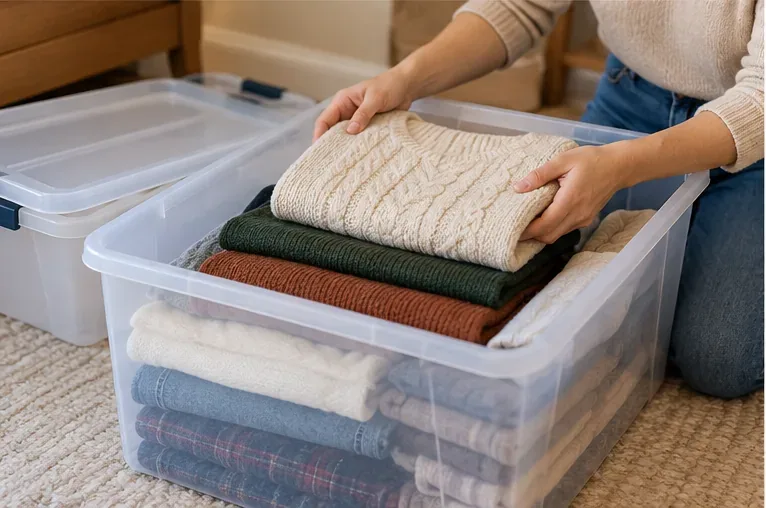
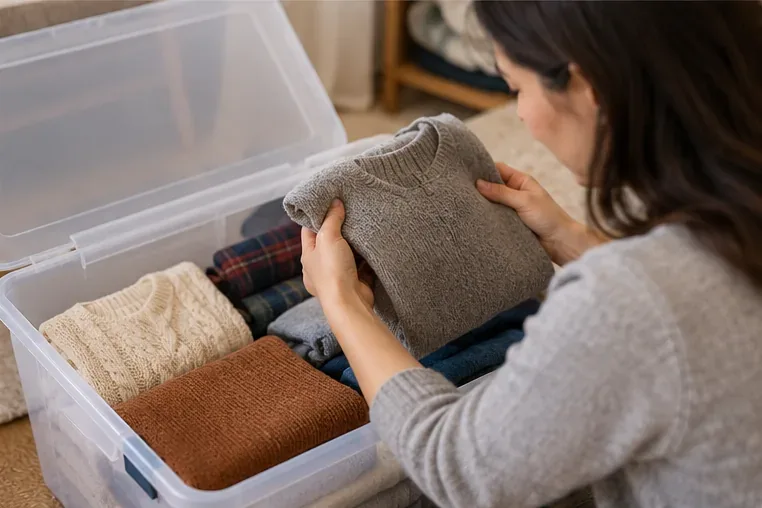
For modern seasonal clothing that is clean and completely dry, a clean, well-sealed plastic bin can be useful because it blocks dust and helps exclude clothes moths. NPIC specifically recommends storing cleaned items in airtight containers as part of clothes-moth management. Do not compress delicate knits so tightly that they are distorted, and avoid packing a bin so densely that inspection becomes difficult.
For antique, fragile, or heirloom textiles, do not automatically copy the same approach. Smithsonian guidance notes that historic textiles can be vulnerable to condensation and recommends archival materials, clean cotton or muslin coverings, and carefully controlled storage conditions rather than simply sealing them in plastic. Acid-free boxes and tissue may be more appropriate for valuable pieces.
Silica gel and other desiccants absorb moisture from a limited volume of air. They can be useful inside a small closed container that starts out dry, but they are not a substitute for controlling a humid room or repairing a leak. Once saturated, many products must be replaced or regenerated exactly as their instructions specify. Avoid loose powders or products that could spill onto fabric.
If you use a moisture absorber that collects liquid, keep it outside clothing bins and where it cannot tip onto textiles. Never place any chemical product directly against fabric unless its label specifically allows that use.
Storage is a process, not a one-time seal-and-forget task. Check the room humidity and open the storage periodically. Look for condensation, a musty smell, discoloration, fuzzy growth, new holes, webbing, shed larval skins, or insect activity. If the outside of a bin feels damp or the closet smells musty, deal with the moisture source before repacking.
For pest monitoring, pheromone traps can help detect clothes moths, but they are monitoring tools rather than a complete treatment. NPIC recommends continuing to monitor even after cleaned items are placed in airtight containers. Its clothes-moth page was updated May 1, 2026 and can be consulted at National Pesticide Information Center: Clothes Moths.
| Goal | Better first choice | Why |
|---|---|---|
| Reduce humidity | Dehumidifier or air conditioner plus a hygrometer | Controls moisture in the room rather than masking it. |
| Keep insects out | Clean garments plus a sealed container for ordinary clothing | Removes food residues and creates a physical barrier. |
| Protect heirloom textiles | Archival box, appropriate tissue or washed muslin, stable room conditions | Reduces light, dust, abrasion, and damaging humidity swings. |
| Detect moth activity | Pheromone monitoring traps | Helps reveal adult moth presence so you can inspect susceptible items. |
| Manage a small dry enclosure | Properly used desiccant | Can buffer limited moisture but cannot correct a damp room. |
This traps the problem inside the container. If clothes are not fully dry, delay packing.
Fragrance is not humidity control. Some aromatic products are commonly marketed as moth deterrents, but UC Integrated Pest Management notes that little is known about the effectiveness of herbal oils in storage. Use cleanliness, inspection, and physical exclusion as the core strategy. See UC IPM clothes moth guidance.
Cold surfaces can encourage condensation. Leave enough space to inspect the area, improve air movement around storage furniture, and move garments away from known damp zones.
Humidity changes with weather, cooking, showers, air-conditioning cycles, and season. Check at different times, particularly during the most humid part of the year.
A wedding dress, vintage silk, embroidered textile, historic uniform, or fragile wool garment may need conservation-grade storage rather than an ordinary plastic tote. Smithsonian and National Park Service textile guidance emphasizes stable humidity, darkness, cleanliness, and materials that do not harm the textile over time.
You can protect stored clothes from humidity without mothballs by controlling the environment rather than adding pesticide vapor. Clean and dry the clothes, keep room humidity moderate, use an appropriate enclosure, and inspect the contents over time. For ordinary wardrobes, those steps address both moisture and many pest risks. For heirloom textiles, use conservation-oriented materials and storage methods because the safest enclosure for a modern sweater is not automatically the safest choice for a century-old textile.
Find out why a bathroom mirror streaks after cleaning and follow gentle checks for cleaner residue, hard-water spots, and possible mirror backing damage.
Compare small-entryway storage by floor space, capacity, rental limits, and daily use. Keep shoes, coats, and keys organized without blocking the door.
A warm refrigerator door frame can be normal, while poor gasket grip may signal dirt, obstruction, misalignment, or damage. Learn what to check.
Keep stored clothes dry, fresh, and pest-resistant without mothballs by controlling humidity, cleaning garments, choosing the right container, and checking storage regularly.
Learn why indoor plant leaves turn brown at the edges, how to compare watering, light, humidity, fertilizer, and water quality, and what to check first.
Use this family-friendly balcony checklist to decide what to bring indoors, cover, keep outside, or let go before the first frost in a small space.