Home
» Babies
»
Why Would a Baby Suddenly Reject a Familiar Solid Food?
Why Would a Baby Suddenly Reject a Familiar Solid Food?
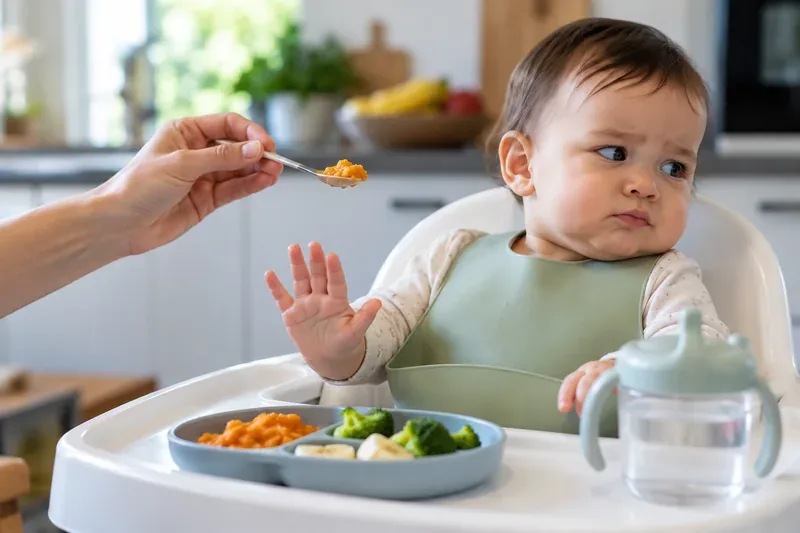
A baby who happily ate oatmeal, avocado, yogurt, or sweet potato last week may suddenly clamp their mouth shut, turn away, push the spoon, or cry when the same food appears. That change can feel alarming, especially when the food was already familiar. In many cases, though, one refused food or one difficult meal reflects a temporary change in appetite, comfort, timing, texture, or feeding preference rather than a problem with the food itself.
For babies roughly 6 to 12 months old, breast milk or infant formula still provides most of their nutrition while solid foods gradually become more important. The CDC notes that intake can vary from day to day, and both the CDC and NHS emphasize following a baby's hunger and fullness cues rather than forcing a set amount. See the CDC guidance on how much and how often to feed and the NHS guidance on first solid foods.
A baby may refuse a familiar food even when it is offered in a calm, familiar setting; the reason can be as simple as fullness, fatigue, discomfort, or wanting more control over the meal.
Start with the simplest explanation: your baby may not be hungry right now
Babies do not eat the same amount at every meal. A larger milk feed, a shorter interval since the last feeding, fatigue, distraction, or simply a lower appetite can make a familiar solid food suddenly unappealing. Turning the head away, closing the mouth, slowing down, or becoming distracted can be fullness cues rather than evidence that your baby now dislikes the food.
The easiest response is to stop the meal without pressure and try again later. Avoid chasing the baby's mouth with a spoon or repeatedly inserting food after they turn away. Responsive feeding means the adult decides what safe food is offered and the baby decides whether and how much to eat. The NHS specifically advises waiting until another time if a baby is not interested and not forcing them to eat.
Next, check whether the food is actually the same experience
A food can be “familiar” by name while feeling very different in the mouth. A new brand of yogurt may be thicker or more tart. Oatmeal may have cooled and become sticky. Banana may be less ripe. A puree may be lumpier than before, or a finger food may now be cut differently.
Texture matters because eating solids is a developing motor skill. The CDC explains that babies commonly progress from smooth mashed or pureed foods toward thicker, lumpier, finely chopped, and finger-food textures as their skills improve. During this learning period, coughing, gagging, or spitting food out can occur with unfamiliar textures. Read the CDC guidance on tastes and textures.
If rejection happens only with one preparation, compare the details: temperature, thickness, lump size, seasoning, serving utensil, and whether the baby is spoon-fed or allowed to self-feed. You can return temporarily to a texture the baby handles comfortably, then advance again gradually rather than turning every refusal into a battle.
Teething, minor illness, tiredness, or mouth discomfort can temporarily change eating
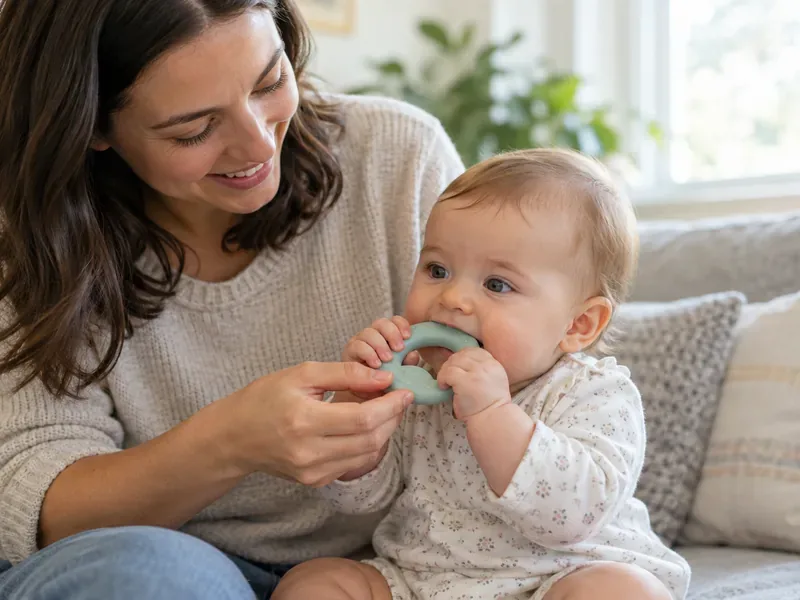
A baby who is teething, congested, tired, or generally unwell may be less interested in solids even if milk feeds continue. Cambridge University Hospitals notes that food refusal can occur when a baby is tired, unwell, or teething, as well as when taste, texture, or a desire for more independent self-feeding changes. Their practical advice is to offer food when the baby is rested and comfortable and to keep portions small. See the CUH feeding guidance.
Look for context rather than assuming the food itself is the cause. Is the baby drooling more than usual, chewing on everything, congested, unusually sleepy, irritable, or recovering from a fever? Are there visible mouth sores? If eating appears painful, the baby also refuses liquids, or discomfort persists, contact the pediatrician rather than repeatedly testing the same food.
Your baby may be asking for more control, not rejecting the flavor
As motor skills improve, some babies become less willing to be spoon-fed and more interested in touching food, holding a spoon, or feeding themselves. A baby may reject puree from your spoon but willingly pick up a soft piece of the same food.
That does not mean every food should become finger food immediately. Preparation still has to match the baby's developmental skills and reduce choking risk. The CDC recommends appropriate shape, size, and texture, upright positioning, calm meals, and continuous adult supervision. Review the CDC choking-hazard guidance before changing how a food is served.
Repeated exposure is useful, but pressure is not
One rejection does not establish a permanent dislike. The CDC notes that young children may need repeated exposure before accepting a food, and children can later refuse foods they previously liked. The NHS similarly describes days when babies eat more, eat less, or reject everything. See the CDC guidance on picky eating.
A practical approach is to offer a small amount again on another day alongside one or two other familiar foods. Keep the mood neutral. Let the baby touch or smell the food. Eat together when possible. If the baby turns away, remove the food without bargaining, distracting, bribing, or forcing.
When a sudden refusal could signal an allergy or another medical issue
Food refusal by itself is not enough to diagnose a food allergy. However, a familiar food should not automatically be considered harmless if other symptoms appear after eating it. The American Academy of Pediatrics lists possible food-allergy symptoms including hives, swelling, vomiting, diarrhea, coughing, wheezing, throat symptoms, and trouble swallowing. In infants, reactions may also look like marked fussiness, unusual crying, drooling, or reduced muscle tone. See the AAP's food-allergy guidance.
Get emergency help for signs of a severe allergic reaction such as trouble breathing, wheezing, sudden throat or swallowing difficulty, swelling of the lips or tongue, collapse, or rapidly worsening symptoms. The AAP identifies epinephrine as the recommended emergency treatment for anaphylaxis when it has been prescribed and is available; emergency medical services should still be contacted. See the AAP's anaphylaxis guidance for children.
Contact your child's clinician promptly if refusal is persistent or expanding beyond one food, especially if it is accompanied by recurrent vomiting, pain with swallowing, repeated coughing or choking during meals, poor weight gain, unusual lethargy, or a meaningful drop in milk or fluid intake. A clinician may need to look for oral pain, illness, gastrointestinal problems, swallowing difficulty, or another feeding issue rather than treating the situation as ordinary food preference.
What to try, from easiest to more involved
End the current meal calmly. If your baby is turning away or closing their mouth, stop and try again at another meal.
Check timing. Offer solids when the baby is awake and comfortably hungry, not immediately after a large milk feed and not when overtired.
Compare the preparation. Check temperature, thickness, texture, brand, ripeness, seasoning, and portion size.
Offer a tiny amount. A teaspoon or a few soft pieces can feel less overwhelming than a full bowl.
Give more control. When developmentally appropriate, let the baby touch the food, hold a spoon, or self-feed safely prepared pieces.
Reoffer without pressure. Try the food again on another day rather than repeatedly presenting it in the same sitting.
Track associated symptoms. Note whether refusal follows a specific food and whether rash, swelling, vomiting, coughing, wheezing, diarrhea, pain, or unusual lethargy appears.
Call the pediatrician when the pattern persists or feels medically different. Especially seek advice if the baby is refusing multiple foods or fluids, appears to have pain, has feeding-skill concerns, or growth and hydration are affected.
How to tell whether your approach is working
Judge progress over several meals, not one sitting. A reassuring pattern is that your baby remains alert and generally well, continues normal milk feeds, has usual wet diapers, accepts at least some other age-appropriate foods, and can encounter the refused food without escalating distress. Acceptance may mean touching, licking, tasting, or eating a small amount; it does not have to mean finishing a serving.
If the food is still refused after several calm reoffers but the baby is otherwise thriving, you can pause it for a while and continue offering dietary variety. If the refusal becomes broader, persists alongside pain or feeding difficulty, or is linked to symptoms of allergy or illness, the next step is medical assessment rather than more persistence at the table.
The key distinction is between a baby saying “not now” and a baby showing signs that eating is uncomfortable or unsafe. Watching the whole pattern—appetite, mood, milk intake, texture skills, associated symptoms, and growth—gives far more useful information than whether one familiar food was accepted today.