Home
» Babies
»
Why Some Babies Crawl Backward Before They Move Forward
Why Some Babies Crawl Backward Before They Move Forward
Some babies push themselves backward when they first get up on their hands and knees. That can happen because pushing through the arms is easier for them than coordinating their legs to propel the body forward. As strength, balance, and timing develop, a baby may move forward, use another crawling style, or skip hands-and-knees crawling altogether.
The American Academy of Pediatrics (AAP) describes backward pushing as a possible part of early movement: a baby’s arm muscles may be stronger than the legs at that stage. It is a common explanation, not a way to diagnose a child or predict exactly when forward crawling will begin. A baby’s movement pattern needs to be understood alongside other skills and the child’s overall development.
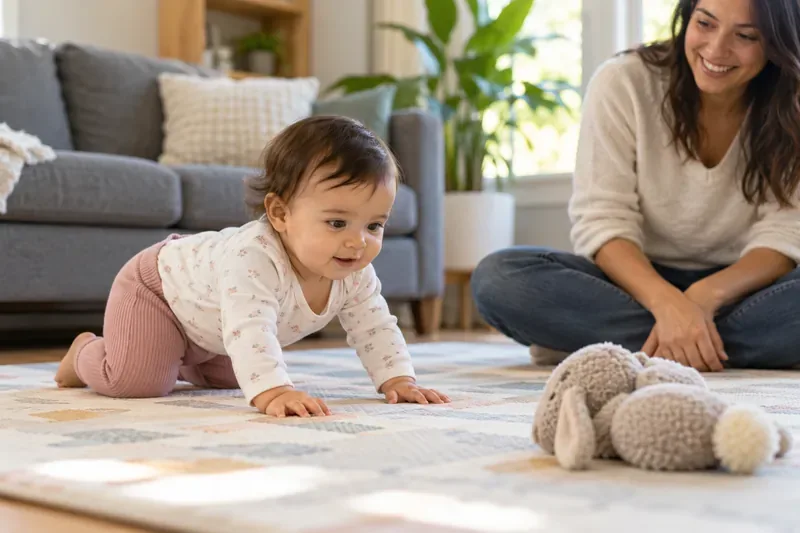
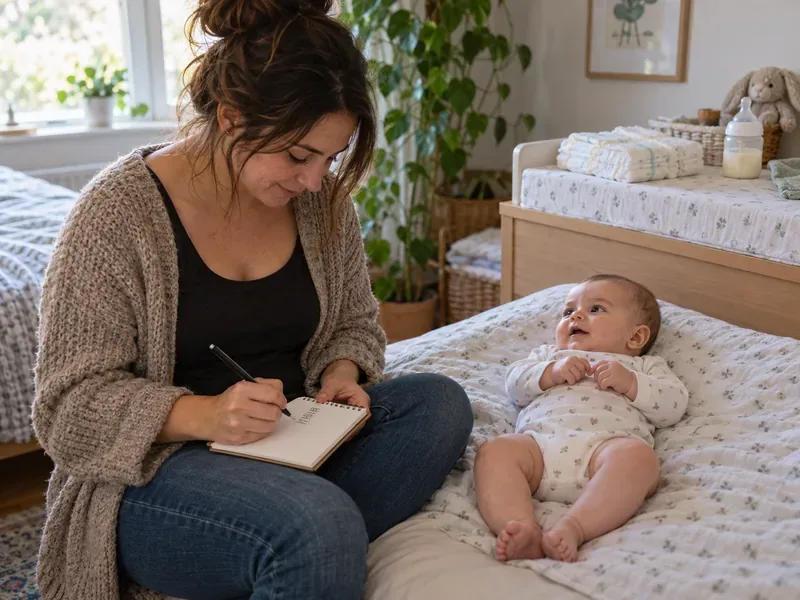
A supervised floor-play moment shows a baby practicing weight-bearing through the hands while a caregiver stays close.
Why can pushing with the arms send a baby backward?
When a baby presses both hands into the floor, the push can shift the body away from the hands. If the legs are not yet pushing in a coordinated way, the baby may slide or rock backward instead of traveling toward a toy. In other words, the baby has found a way to generate movement, but the forward pattern is still emerging.
Forward crawling asks for more than arm strength. A baby needs to steady the trunk, shift weight from side to side, and coordinate the arms and legs so one side can move while the other supports the body. Those pieces do not necessarily appear all at once. Backward motion may show up during practice on the floor while a child works out balance and how their limbs affect movement.
What you can do: notice whether the baby is also rocking, reaching, pivoting, rolling, scooting, or trying to get into and out of sitting. These observations give a fuller picture than the direction of one movement.
Backward motion is one of several movement styles
“Crawling” can describe different ways babies move independently. The AAP lists hands-and-knees crawling, belly crawling, bear crawling, bottom scooting, and crab-style movement that may go backward or sideways. Some babies roll to get where they want to go. A child may also use more than one style at different times.
It helps to watch how the movement happens. One baby may press through both hands and slide the body backward from a hands-and-knees position. Another may sit and use the hands and legs to scoot backward. These are not identical patterns, and a short description or video can help a pediatrician understand what a parent has noticed.
What you can do: describe the position (on the belly, hands and knees, or seated), which limbs move, whether both sides are used, and what the baby can do in other positions. If you are concerned, show a brief video at a well-child visit.
Common claims: what is supported, what depends, and what is not known
“Backward crawling means something is wrong.”
What is supported: backward or sideways movement is included among normal crawling variations in AAP parenting guidance, and babies can use a range of movement styles.
What depends on the child: a clinician considers age, the pattern over time, symmetry, strength, other motor skills, and medical history. Backward motion by itself cannot confirm a delay or rule one out.
Useful action: if the baby uses both sides and continues gaining skills, mention the pattern at a routine visit if you want reassurance. If movement seems persistently one-sided or you have other concerns, contact the pediatrician rather than waiting for the baby to crawl forward.
“Every baby must crawl forward before walking.”
What is supported: the AAP says not every infant crawls in the traditional manner, and some babies use alternatives such as scooting or belly movement. CDC’s current 9-month milestone checklist includes skills such as getting into a sitting position and sitting without support; it does not list crawling as a required item on that checklist.
What that does not mean: a milestone checklist is not a full developmental examination, and the absence of crawling from one checklist does not mean parents should ignore their child’s movement. It means crawling forward is not the only useful sign to watch.
Useful action: track the broader pattern—how the baby sits, reaches, moves, uses both sides, and continues learning. Ask the child’s clinician how to interpret those skills together.
“Skipping crawling causes later reading or learning problems.”
The AAP says there is no scientific evidence for the old claim that skipping crawling, by itself, raises a child’s risk of later reading or learning disorders. Development does not have to follow one fixed sequence in every detail.
Useful action: do not force a particular crawl pattern or buy a product to make a baby crawl. Bring specific concerns about movement, communication, or learning to the pediatrician, who can consider the whole child and recommend screening when appropriate.
How to encourage movement safely
Offer supervised time to play on a firm, clear floor while the baby is awake. Sit nearby, talk, and place a safe toy a little beyond reach so the child has a reason to reach, roll, scoot, or crawl. CDC suggests putting toys on the ground a little out of reach and encouraging a baby to crawl, scoot, or roll to get them. The goal is an inviting opportunity, not a test the baby has to pass.
Stay within arm’s reach during floor play, especially around furniture, stairs, and raised surfaces.
Keep small objects, button batteries, cords, and other choking or injury hazards off the floor.
Use a stable play surface with enough room to move; do not place a baby on a bed or sofa to practice.
Let the baby rest or change position when tired or upset. Avoid pulling the limbs into a crawl or repeatedly positioning the baby in a way they cannot manage comfortably.
Safe, awake floor play gives babies chances to explore movement. It does not guarantee a particular skill or timeline. For sleep, always follow current safe-sleep advice from your child’s health professional; supervised play on the tummy is different from placing a baby on the stomach to sleep.
When should you bring it up with a pediatrician?
Ask for guidance if the baby consistently drags one side, strongly favors one arm or leg, seems unusually difficult to move, stops doing a skill they previously had, or is not progressing in other areas that concern you. These observations do not identify a cause on their own, but they are useful reasons to discuss development. Also mention if your baby was born prematurely or has a medical condition that affects movement; the clinician can interpret progress in that context.
The CDC advises parents not to wait if a child is missing one or more milestones, has lost skills, or a parent has another concern. Talk with the child’s doctor and ask whether developmental screening or a closer evaluation is appropriate. A parent does not need to prove that something is wrong before asking.
For an appointment, note when the backward movement began, how often it happens, which body position the baby uses, and whether both sides participate. If safe and practical, bring a short video taken during ordinary play. Share what else the baby can do, rather than focusing only on whether forward crawling has started.
The practical takeaway
Babies may crawl backward because their arms can push before their legs and body are coordinated for forward travel. This pattern can be part of normal motor exploration, and crawling styles vary. The direction alone is not a diagnosis or a reliable prediction. Offer safe floor time, watch how the baby uses the whole body, and discuss persistent asymmetry, loss of skills, or any broader concern with the pediatrician.