Home
» Parenting
»
How Can Separated Parents Keep Bedtime Rules Consistent Across Homes?
How Can Separated Parents Keep Bedtime Rules Consistent Across Homes?
Separated parents can make bedtime feel predictable across two homes by agreeing on a few shared anchors: enough sleep for the child’s age, a familiar wind-down sequence, and a calm handoff. The bedrooms and every rule do not have to be identical. A child can adapt to different homes more easily when the important cues are clear and adults avoid making bedtime a contest.
As of October 1, 2026, the pediatric guidance reviewed for this article supports regular routines and age-appropriate sleep, but does not prescribe one exact clock time that every household must follow. The right time depends on the child’s wake-up schedule, age, naps, health, and family logistics. The useful goal is consistency in what helps the child settle and how much opportunity they have to sleep.
Start with the child’s sleep need, not a competition between homes
A common assumption is that “consistent” means the same lights-out time to the minute at both homes. Pediatric recommendations focus on regular sleep and sufficient total hours; they do not set a universal two-household clock-time rule. The American Academy of Sleep Medicine recommends, for healthy children, 10–13 hours per 24 hours for ages 3–5, 9–12 hours for ages 6–12, and 8–10 hours for teens 13–18. These ranges include naps for younger children. They are population guidelines, not a diagnosis or a bedtime prescription for an individual child.
Use the child’s usual wake time and sleep needs to choose a reasonable bedtime window with the other parent. If one home has an earlier school bus, a small difference in lights-out may be sensible if the child still has enough time to sleep. Infants younger than 4 months are not included in the AASM duration recommendations above; ask the child’s pediatric clinician about an age-appropriate sleep plan for a baby or a child with a medical or developmental condition.
Two adults review a weekly calendar together, a practical way to coordinate bedtime expectations around school and handoff times.
Four practical steps for keeping bedtime consistent in two homes
1. Agree on a small set of shared anchors
Choose a few things that matter most rather than negotiating every household detail. For example: a target bedtime range on school nights, brushing teeth, one quiet activity such as reading, a clear lights-out cue, and a plan for what happens if the child wakes during the night. Keep the agreement short enough that both adults can remember it.
Make the routine fit the child. The AAP’s “Brush, Book, Bed” guidance offers a simple sequence for young children, but older children may prefer a shower, reading independently, or quiet music. The shared part can be the order and calm transition, not identical activities. Write the agreed anchors in a brief note both adults can check; use age-appropriate language if the child will see it.
A parent and child brush teeth together, one familiar step that can help mark the start of bedtime in either home.
2. Keep the sequence familiar, even when the rooms differ
Children often recognize a routine through repeated cues: pajamas, bathroom, a story, a goodnight phrase, then lights out. Each parent can use the same basic sequence in a different bedroom. The American Academy of Pediatrics notes that a predictable routine helps children learn what comes next and may ease bedtime stress.
Pick a routine that fits the time available. If a late return makes the full routine unrealistic, agree on a shorter version instead of rushing through a long list or letting bedtime drift without explanation. Tell the child what will happen: “We have time to brush, read one short book, and then lights out.” This is more concrete than asking the child to decide whether bedtime should happen.
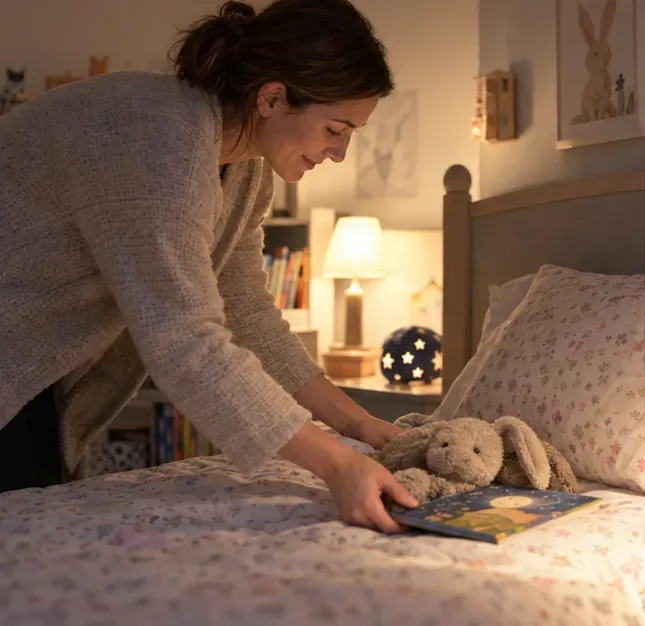
A picture book and a familiar stuffed animal sit beside a child’s bed, showing how familiar bedtime cues can travel between homes.
3. Make handoffs and comfort items easier
Transitions can be tiring even when parents cooperate. If a favorite book, soft toy, night-light, or music helps the child settle, consider keeping a duplicate at each home. The AAP’s separation-specific sleep guidance suggests duplicates of especially favorite bedtime toys, books, or music to reduce problems caused by haste or forgetfulness. A duplicate is an option, not a requirement; ask the child which familiar cue matters most.
Where possible, avoid making the child carry messages or negotiate bedtime rules between adults. Parents can share the practical details directly: whether the child napped, took medication prescribed for bedtime, had a difficult night, or needs an early start. Keep the message factual and brief, and do not ask the child to report which home is “better.”
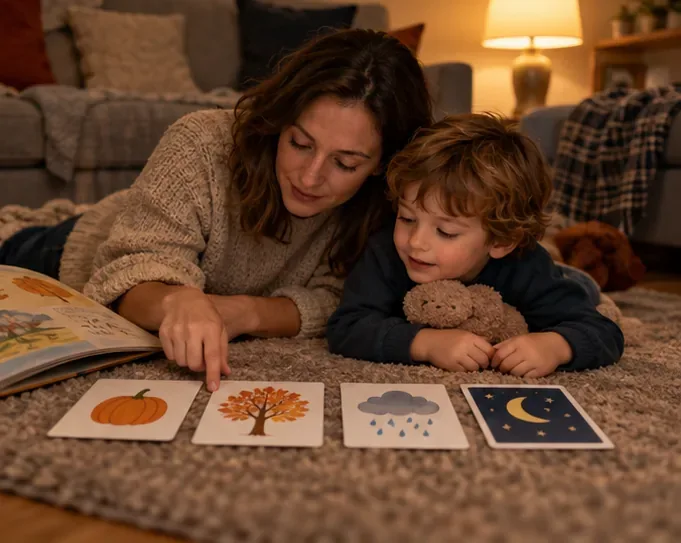
A parent sits beside a child at bedtime and listens, offering reassurance during a quiet settling moment.
4. Review what is working and adjust without blame
For a week or two, track simple observations: approximate lights-out time, wake time, night waking, and how rested the child seems in the morning. Use the same neutral format at both homes if both parents agree. A small log can reveal a practical mismatch, such as a nap ending late or an early school start, without turning one difficult evening into proof that a parent is doing something wrong.
Try one adjustment at a time. If the child takes a long time to settle in both homes, move the routine slightly earlier or make the last part quieter. If the difficulty appears mainly after exchanges, add a predictable transition cue, such as unpacking the comfort item and reading the same short book. Check after several nights rather than judging a new routine after one evening.
Misunderstandings that can make co-parenting harder
“Consistent means identical.” The verified guidance supports predictable routines and enough sleep, not identical rooms, rules, or clock times. Agree on the anchors and allow reasonable differences for each home’s schedule.
“A rough bedtime proves the other parent is causing the problem.” AAP guidance notes that stress around separation can coincide with sleep difficulty or temporary regression, such as renewed night fears or bedwetting. One bad night cannot establish its cause. Record the pattern and respond supportively before drawing conclusions.
“The child should decide which parent’s rules to follow.” Children can share what helps them feel comfortable, but adults should handle the agreement. Ask for the child’s preference about a book or comfort object, then keep the bedtime limit adult-led and predictable.
“Both homes must solve every difference face to face.” Cooperation can help, but the safest and most workable communication method depends on the family’s circumstances. If direct contact is unsafe or consistently escalates conflict, follow any parenting plan or court order and use an agreed written or professional channel where appropriate. Do not put the child in the middle.
When to get more help
Talk with the child’s pediatrician if sleep problems persist, worsen, or affect daytime mood, school, or safety; also ask for guidance about loud snoring, pauses in breathing, or other concerning symptoms. The pediatrician can consider age, health, stress, and the child’s sleep schedule rather than assuming that different household rules are the sole cause. The AAP’s two-home sleep page recommends pediatric follow-up when problems continue after the family situation stabilizes; its guidance is a starting point, not a substitute for individualized care.
If parents cannot agree on basic bedtime anchors, a pediatrician, family therapist, or other qualified neutral professional may help them focus on the child’s needs. When there is a safety concern, prioritize that concern and seek appropriate local support rather than trying to resolve it through a bedtime compromise.
A short plan to try this week
Estimate a realistic sleep window using the child’s age and morning wake time.
Choose three shared bedtime anchors, such as teeth, a quiet activity, and lights out.
Keep a favorite comfort cue available at both homes if the child wants one.
Share brief observations after handoffs and review the pattern before changing the plan.
Expect some variation. Consistency across two homes is less about reproducing the same evening twice and more about giving the child dependable signals, sufficient sleep opportunity, and adults who handle differences calmly.