What to Put in a Nutrition Symptom Diary—and When to Seek Advice

Learn what to record in a nutrition symptom diary, how long to track, what patterns can and cannot show, and which warning signs need prompt care.
A front label may promise “high protein,” “excellent source of fiber,” or “no added sugar,” yet those phrases do not tell you how much you will actually get in the portion you eat—or whether the product is lower in sugar, higher in fiber, or better suited to your needs than another choice. Start with the Nutrition Facts panel, compare products on the same serving basis, and treat front-of-package claims as prompts to verify rather than as a complete nutrition summary.
This guide explains U.S. Nutrition Facts labels. Imported foods may use different reference values, claim definitions, or label formats, so compare products within the same market when possible. Federal dietary guidance has also recently changed: the Dietary Guidelines for Americans, 2025–2030, now says no amount of added sugar is recommended and advises that one meal contain no more than 10 grams. The FDA label still uses a 50-gram Daily Value for added sugars to calculate %DV. Those figures have different purposes: one is current dietary guidance, while the other is a standardized labeling reference.
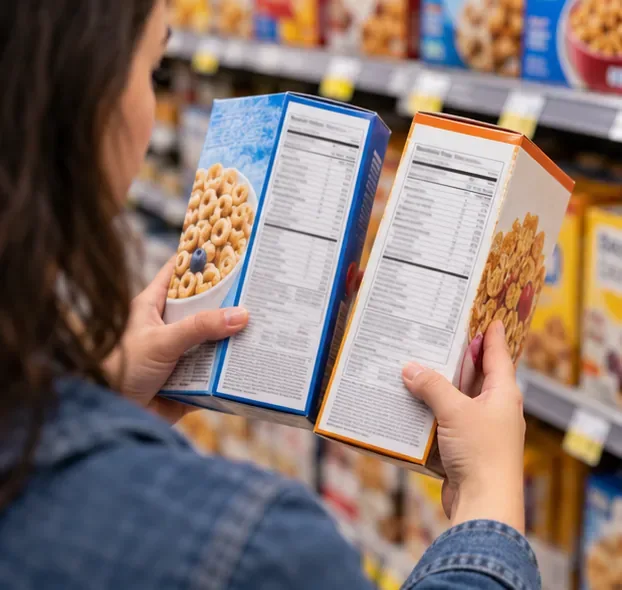
Every number on the Nutrition Facts panel is tied to the stated serving, not necessarily to the amount you plan to eat. FDA serving sizes describe amounts people typically consume; they are not recommendations. Check both “servings per container” and “serving size.” A bottle or pouch that looks like one portion may list more than one serving, and eating the whole package can multiply the protein, fiber, sugar, calories, and sodium shown for one serving.
For a fair comparison, use the same amount of each food. If two snack bars have different serving weights, compare the grams of protein, fiber, and added sugars for the amount you would actually eat. For products with different package serving sizes, you can also normalize the values per 100 grams: divide a nutrient’s grams per serving by the serving weight in grams, then multiply by 100. This is a calculation aid, not a claim that 100 grams is a sensible portion.
| What you want to compare | Where to look | Common trap |
|---|---|---|
| Protein | Protein grams per serving; serving weight; ingredient list | Assuming “high protein” makes the whole product a good fit |
| Fiber | Dietary Fiber grams and %DV | Assuming “made with whole grains” means high fiber |
| Added sugar | Includes Added Sugars grams and %DV | Using Total Sugars alone to judge added sweeteners |
In the U.S. label format, protein is usually listed in grams, but it generally does not have a %DV. FDA may require a protein %DV in specific situations, including when certain protein claims are made; the displayed %DV can account for protein quality. For ordinary shopping, compare grams per the portion you expect to eat. Do not compare one product’s per-container number with another product’s per-serving number.
Protein grams do not describe the food’s full nutritional profile. A bar can contain a substantial amount of protein and also have a large amount of added sugar or saturated fat. A plain yogurt, eggs, beans, fish, nuts, or another food may contribute protein alongside other nutrients, but the best choice depends on the meal, preferences, budget, and health needs. Look at the ingredient list to see the main protein sources, particularly if you avoid dairy, soy, gluten, or other ingredients.
The current U.S. Dietary Guidelines for Americans, 2025–2030, recommend prioritizing protein foods at meals and give a general protein serving goal of 1.2–1.6 grams per kilogram of body weight per day, adjusted to individual calorie needs. This is population guidance, not a personalized prescription or a reason to pursue the largest number on a package. People with kidney disease or another condition requiring a protein target should follow their clinician’s or registered dietitian’s advice instead of calculating a personal goal from a package claim.
On the Nutrition Facts panel, look for “Dietary Fiber,” not just “whole grain,” “multigrain,” or “made with oats” on the front. Those phrases do not state how many grams of fiber are in your portion. FDA’s Daily Value for fiber is 28 grams; the %DV can help compare the contribution per labeled serving. As a general FDA guide, 5% DV or less is low and 20% DV or more is high, but those cutoffs describe a serving’s contribution to the label’s Daily Value, not a clinical target for every person.
Ingredients can add context. Whole grains, beans, peas, lentils, nuts, seeds, fruits, and vegetables are common fiber-containing foods. Some products add isolated fibers such as inulin or other non-digestible carbohydrates. FDA’s definition determines which fibers may be counted as “Dietary Fiber” on the Nutrition Facts panel; not every ingredient marketed as fiber necessarily appears in the same way. A high-fiber claim therefore deserves a look at the panel and the ingredient list, especially if you are comparing a packaged bar with a less processed food.
Fiber can be useful, but more is not automatically better for every person at every moment. If you are increasing fiber, do so gradually and drink fluids as appropriate. If a clinician has prescribed a specific fiber plan, or if you have persistent abdominal pain, vomiting, blood in the stool, or an unexplained change in bowel habits, seek medical advice instead of trying to solve symptoms by choosing a package with a bigger number. These signs do not identify a diagnosis by themselves, but they warrant attention.

On U.S. labels, “Total Sugars” includes naturally occurring sugars and added sugars. The line “Includes Added Sugars” is part of that total; do not add the two figures together. Plain milk and plain yogurt contain naturally occurring lactose, and whole fruit contains naturally occurring sugars. Sweeteners added during processing, including many sugars, syrups, honey, and concentrated fruit or vegetable juices, count as added sugars under FDA labeling rules.
“No added sugar” does not mean “sugar-free.” A product may have natural sugar from fruit or milk, and a no-added-sugar claim does not by itself tell you the product’s calories, protein, fiber, or portion size. Likewise, a “reduced sugar” claim compares a food with a reference product; it does not automatically mean the amount is low. Confirm the exact Added Sugars grams and %DV on the panel and scan the ingredients for words such as sugar, syrup, honey, or ingredients ending in “-ose.”
FDA’s label %DV uses 50 grams as the Daily Value for added sugars. So 10 grams per serving corresponds to 20% DV, which FDA’s general guide calls high for a nutrient on a per-serving basis. The 2025–2030 Dietary Guidelines use a different practical recommendation: they say no amount of added sugar is recommended and one meal should contain no more than 10 grams. Do not treat the FDA 50-gram labeling reference as a recommended personal allowance; %DV is a standard comparison tool, and dietary guidance may change over time.
FDA rules set conditions for regulated nutrient-content claims, but a compliant claim still describes a limited feature. The updated FDA “healthy” claim also has criteria involving food groups and limits for added sugars, saturated fat, and sodium. A package claim cannot tell you whether the item fits an individual medical diet or your overall eating pattern.
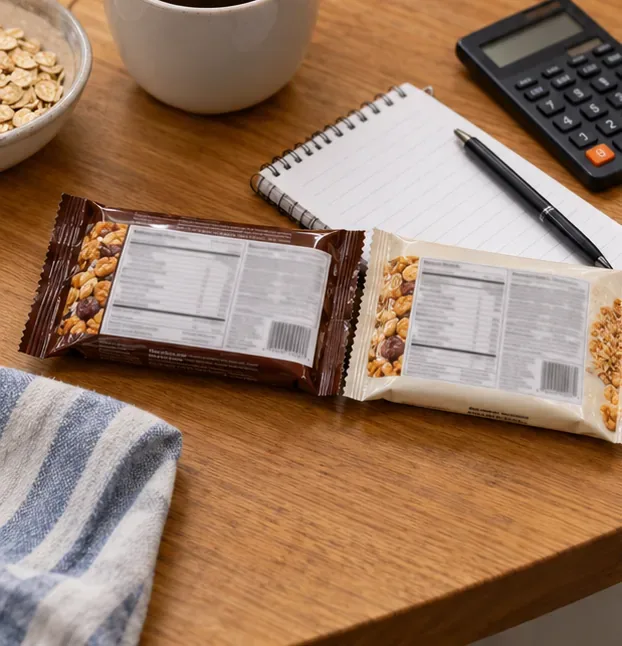
For example, if one cereal box lists a smaller serving than another, the first may appear lower in sugar simply because the labeled portion is smaller. Recalculate both for the bowl size you actually eat, then compare fiber and protein on that same basis. If you want a lower-added-sugar option, use Added Sugars rather than Total Sugars alone; if you want more fiber, check Dietary Fiber grams rather than relying on “whole grain” printed on the front.
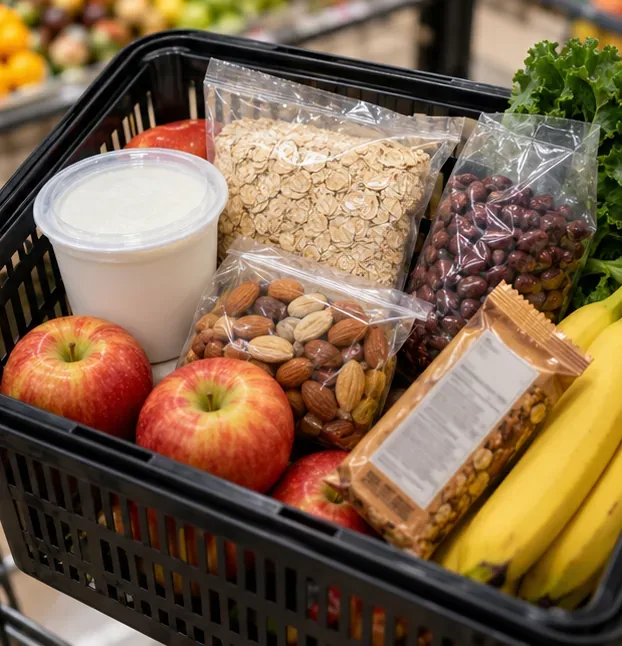
For most routine shopping, checking serving size and the three relevant lines is a practical way to avoid being steered by a large front claim. If you have a prescribed protein or carbohydrate target, chronic kidney or digestive disease, food allergies, or a history of disordered eating, ask your health care professional or registered dietitian how to apply labels to your situation. If a package appears to omit required information, has a damaged or unreadable label, or makes a claim that conflicts with the ingredient list, choose a different product and consider contacting the manufacturer or the appropriate food-safety authority. Labels can support informed choices, but they cannot diagnose a health problem or replace individualized nutrition advice.
For details, see the FDA guide to the Nutrition Facts label, its %DV explanation, and the FDA explanation of added sugars. For current federal dietary guidance, read the Dietary Guidelines for Americans, 2025–2030. This article reflects those sources as reviewed September 30, 2026; label rules and dietary guidance are not interchangeable, and individual needs vary.
Learn what to record in a nutrition symptom diary, how long to track, what patterns can and cannot show, and which warning signs need prompt care.
Learn why nutrition concerns can affect people differently, what can change test results, how to prepare for an appointment, and when symptoms need prompt care.
Learn how to compare protein, fiber, and added sugar on U.S. food labels, check serving sizes, and avoid being misled by front-of-package claims.
Learn when a brief appetite or hydration concern may be managed at home, what gentle steps to try, and which nutrition warning signs need prompt medical care.
See how meal routines, food restrictions, medicines, alcohol, and hydration can affect nutrition—and which detox and supplement claims have weak evidence.