Home
» Sức khỏe gia đình
»
How to Build One Accurate Medicine List for Your Whole Family
How to Build One Accurate Medicine List for Your Whole Family
Illustrative example: Maya and Jordan share care for their school-age child, Eli, and help Maya’s father manage his prescriptions. After a clinic visit, the family realizes that an old printed list omits an over-the-counter product and still shows a medicine that was stopped. This fictional example is a practical thread, not a real patient story or a test of a medication system.
A dependable family medicine list is one shared, current place to find the right information for each person—without mixing one person’s medicines with another’s. Keep an individual section for every adult and child, record prescription and nonprescription products, and confirm unclear instructions with a pharmacist or prescriber. A list supports care conversations; it does not authorize anyone to start, stop, share, or change a dose.
1. Gather what each person actually uses
Maya and Jordan begin by collecting prescription containers, over-the-counter (OTC) packages, inhalers, eye or skin medicines, vitamins, minerals, herbal products, and supplements. They check bedside tables, bags, and the places where each person keeps medicines. For Eli, they include medicines used only when needed, even if he has not taken one recently.
Use more than memory. Compare containers with recent visit summaries and, when needed, ask the pharmacy or clinician to clarify the current directions. A pharmacy fill history can help, but a filled prescription does not prove that someone is taking it now. A stale portal or discharge list can also lag behind a real change. The person or caregiver should say what is actually used, then the clinician or pharmacist can help resolve differences. This process is often called medication reconciliation; AHRQ’s patient-safety discussion of medication reconciliation describes why comparing sources matters.
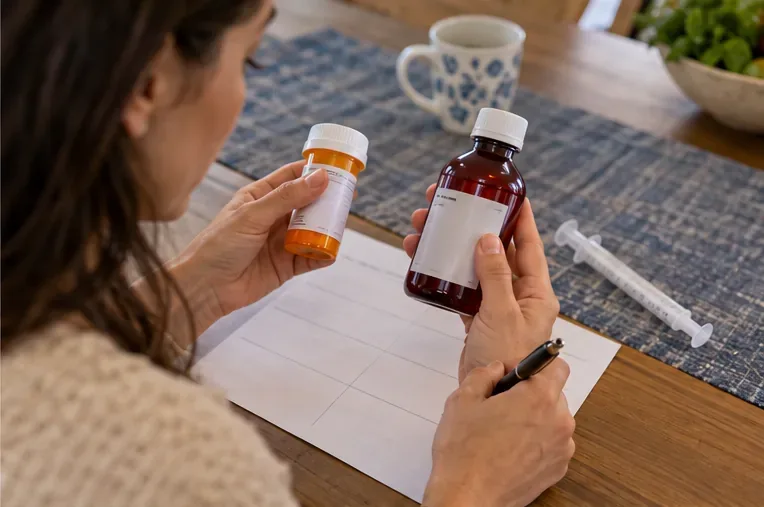
Maya and Jordan gather the containers used by each family member before writing the list.
Record products even if they seem ordinary. Pain relievers, allergy medicines, cold remedies, sleep aids, topical creams, vitamins, and supplements can matter when a professional checks for duplicate ingredients or interactions. If a product is occasional, label it “as needed” and note the reason and the directions on its package or prescription. Do not guess whether a discontinued or rarely used item belongs in the active list; mark it for confirmation.
2. Make a separate, readable section for each person
One shared file can be convenient, but each person needs a clearly separated list. Put their full name and date of birth at the top; include a parent or caregiver’s contact information when useful. Keep the child’s information distinct from the adults’ entries. A simple table or one-page note is enough if it is readable and can be updated.
For each active medicine, write down:
The generic name and, if helpful, the brand name exactly as it appears on the package.
Strength or concentration and form, such as tablet, inhaler, cream, or liquid.
The prescribed or label-directed amount, with units; route (by mouth, on skin, inhaled, and so on); and schedule. For an as-needed medicine, include the reason and any maximum or interval stated in the directions.
Who prescribed it and the reason it was prescribed, if known. If the reason is uncertain, write “confirm” rather than inventing one.
Start date or a review note if known, plus the pharmacy or prescriber contact when that helps.
Allergies or prior medicine reactions in a separate, prominent section, including what happened and when, if known. Do not label an expected side effect as an allergy without professional guidance.
For children, add a recent weight and the date it was measured if the child’s clinician uses weight-based dosing. Keep the weight clearly attached to that child, not to the whole family. Do not calculate a dose from an old weight or copy an adult dose. Child dosing and age limits vary by product and circumstance; FDA advises caregivers to follow the package directions, use the correct measuring device, and ask a clinician or pharmacist before combining medicines. See the FDA’s guidance on children’s OTC medicines.
Maya checks the product details and records the directions as written, rather than estimating a child’s dose.
3. Check child-specific directions instead of translating adult directions
Children are not simply smaller adults. A pediatric dose may depend on the specific medicine, the child’s age or weight, the product concentration, and the clinician’s instructions. Two bottles with similar names may contain different strengths or active ingredients. Combination cold products can also overlap with a separate fever or pain medicine.
For liquid medicines, copy the dose in the same unit used in the directions—often milliliters (mL)—and note the measuring device. Use the syringe, cup, or other device intended for that product, not a kitchen spoon. If a label is unclear, the dose tool is missing, or the instructions conflict with another source, pause and ask the pharmacist or prescriber to demonstrate and write down the directions. Do not infer a child’s dose from an adult product or from a previous illness. The American Academy of Pediatrics’ guide to liquid medicines for children explains why product strength and measurement units matter.
In the fictional household, Maya sees that Eli’s bottle and an older note do not use the same concentration. She does not convert the old instruction herself. Instead, she asks the dispensing pharmacist which directions are current and updates the list only after they are clarified. That is a useful response to an information mismatch, not a reason to change treatment independently.
4. Review, update, and share the same version
Maya and Jordan sit down with Eli’s caregiver and compare each entry with the container or a verified instruction. They move stopped medicines to a clearly marked “no longer taking—verify date” section instead of leaving them mixed into the active list. They do not erase a medicine simply because it is temporarily unavailable or because a person missed doses; they ask the clinician what status to record.
Put a “last checked” date on the list and update it when a medicine is started, stopped, changed, or used differently, and after a hospital, urgent-care, or specialist visit. At regular appointments, ask the doctor or pharmacist to review the list for accuracy, duplicate ingredients, interactions, and unclear directions. Bring the list and, if requested, the containers. MedlinePlus recommends listing prescription and OTC medicines, vitamins, herbs, and supplements, and reviewing the record with a health professional; see MedlinePlus guidance on keeping medicines organized.
The family checks that each item belongs to the correct person and that the active directions match current instructions.
Choose one master copy and a practical backup: a secure phone note, a printed copy in a wallet or emergency folder, or both. Decide who is allowed to edit it so duplicate versions do not drift apart. Protect personal information: use a phone passcode, share only with people involved in care, and avoid posting the list publicly. Keep medicines in their original labeled containers when possible, locked or stored out of children’s reach; the list is not a substitute for safe storage. If a school, camp, or another caregiver needs instructions, provide only the relevant child’s current information and follow that organization’s own forms and clinician requirements.
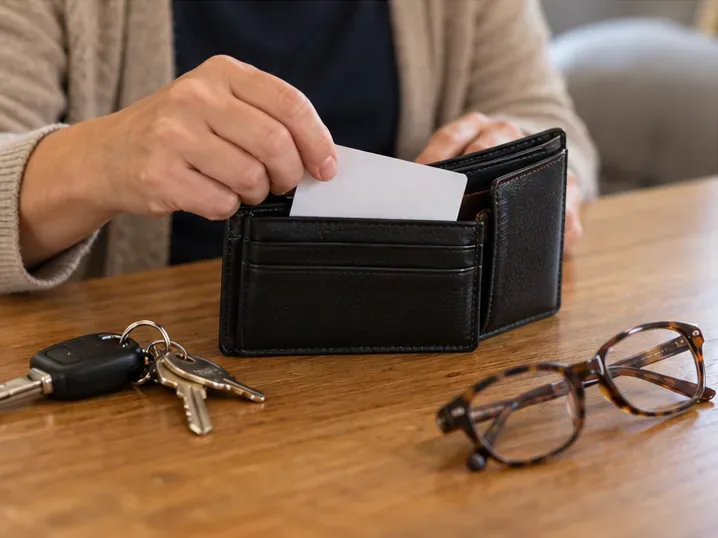
Jordan keeps a current copy available for appointments and makes sure the phone backup is protected.
Common mix-ups and how to correct them
“The pharmacy list is the complete truth.” It can show what was dispensed, but not whether the person currently takes it or how instructions later changed. Compare it with the person’s report and current label, then clarify discrepancies.
“Only prescriptions count.” OTC products, creams, inhalers, vitamins, herbs, and supplements can be relevant too. Add them and note occasional use.
“A medicine with the same name has the same strength.” Concentrations and formulations can differ. Record the exact package details and ask a pharmacist when they do not match.
“An old reaction note proves an allergy.” Record the observed symptom and the suspected product without making a diagnosis. A clinician can help decide whether it was allergy, side effect, or another cause.
Confusion, an incomplete old list, or uncertainty about what is active are common reasons to reconcile information; they do not by themselves establish that anyone has been harmed. The safe next step is to verify the facts, not to stop or adjust a prescribed medicine on your own.
When is a list problem urgent?
Routine discrepancies can usually be clarified with a pharmacist or prescriber. Contact them promptly if a child has an unexpected symptom after taking a medicine, if the amount or timing may have been wrong, if two products may share an ingredient, or if the written directions conflict. For a possible overdose or accidental ingestion in the United States, contact Poison Control at 1-800-222-1222 or use its official online service; do not wait for symptoms to appear. The Poison Control urgent-help guidance says to call 911 if the person collapses, has a seizure, has trouble breathing, or cannot be awakened. Outside the United States, use your local poison center or emergency number.
Breathing trouble or swelling of the face or mouth after a medicine needs immediate attention. For severe symptoms, call emergency services now; a medication list should help responders identify what was taken, not delay care. A new rash, vomiting, or another unexpected reaction also warrants prompt medical advice, especially in a child, but the appropriate response depends on severity and context. This article cannot determine the cause of a symptom or decide whether a medicine is safe for a particular person.
A quick accuracy check
Before relying on the family list, ask: Does every person have a separate section? Are all current prescription and nonprescription products included? Do the name, strength, dose, route, and schedule match an authoritative current instruction? Are child-specific details tied to the right child? Are stopped items visibly inactive, and is the “last checked” date current? Can a caregiver find the list quickly and reach the relevant pharmacy or prescriber? If an answer is no, mark what is uncertain and resolve it with the person’s clinician or pharmacist.
The aim is not a perfect-looking spreadsheet. It is a concise, honest record that helps family members and health professionals compare what is actually being used with the intended plan—especially when care changes or time is limited.