Home
» Giới tính
»
Can Stress, Dehydration, or Poor Sleep Make Sex Concerns Worse? How to Tell
Can Stress, Dehydration, or Poor Sleep Make Sex Concerns Worse? How to Tell
Yes—stress and too little sleep can make sexual desire, arousal, erections, or comfort feel worse for some people. Dehydration can cause fatigue, thirst, and dizziness, which may make intimacy less comfortable. But ordinary dehydration is not established as a direct explanation for persistent sexual problems, and none of these factors rules out a medical cause.
Hypothetical example—not a real person or test: Jordan has a demanding week, sleeps poorly for two nights, drinks little during a hot day, and notices less interest in sex and less reliable arousal that evening. That timing makes stress, fatigue, and low fluid intake worth noticing. It does not prove that any one of them caused the change. The practical task is to look for a pattern while watching for warning signs.
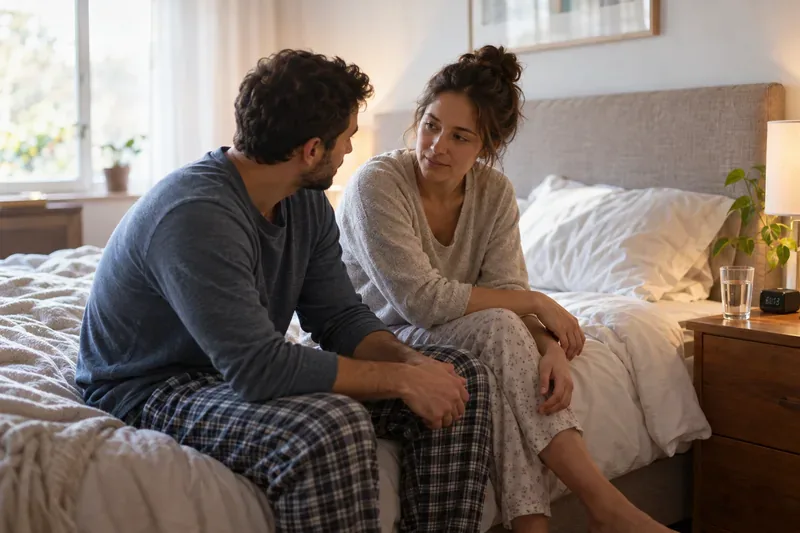
Two adults talk quietly on a bed beside a glass of water and an alarm clock.
What can these factors affect?
“Sex concerns” can mean different things: lower desire, difficulty becoming aroused, erection changes, less lubrication, difficulty reaching orgasm, or pain. A temporary change in one area does not automatically mean a disorder. Sexual response depends on physical health, emotions, medications, relationships, and the situation. ACOG notes that stress, anxiety, depression, sleep, and other health factors can affect sexual well-being; the American College of Obstetricians and Gynecologists’ sexual-health guidance discusses these influences.
Possible trigger
What it may do
What it does not prove
Stress, worry, or pressure to perform
May lower desire or distract from arousal; anxiety and stress can also cause or worsen erection difficulties.
It does not show that symptoms are “only psychological.” Physical and emotional factors can overlap.
Poor sleep or fatigue
Can leave someone less rested, less interested, or less able to focus on pleasurable sensations.
One poor night does not diagnose a sleep disorder or explain a repeated change by itself.
Dehydration
Can cause thirst, tiredness, and dizziness; feeling unwell can make sex less comfortable or appealing.
Evidence does not establish mild dehydration as a general direct cause of ongoing erection, desire, lubrication, orgasm, or pain concerns.
Stress and performance pressure
Stress can narrow attention toward worries—such as whether an erection will last, whether a partner is satisfied, or whether sex will hurt. That pressure may interrupt arousal or reduce desire. NIDDK lists anxiety, depression, and stress among factors that can cause or worsen erectile dysfunction (ED), and it also lists blood-vessel, nerve, hormone, medication, and other health factors. This is why “I have been stressed” can be a useful clue, but not a diagnosis. See NIDDK’s overview of ED symptoms and causes.
For Jordan, a high-pressure week could be relevant, especially if the change appeared during a stressful evening. A lower-pressure, mutually wanted kind of intimacy—or choosing to pause—may make the moment more comfortable. No one needs to push through sex to test whether stress is the cause.
Poor sleep and fatigue
Sleep loss can affect mood, energy, and concentration. Those changes may make desire or arousal less likely in the moment, but sleep is only one part of sexual health. Persistent daytime fatigue, loud snoring, or waking up gasping deserves attention in its own right; a health professional can consider whether a sleep problem or another condition is involved. ACOG’s guidance on sexual health includes not getting enough sleep among factors that can affect sexual function.
If Jordan feels more rested on another day and the concern is absent, that is useful context, not proof. If it keeps happening despite better rest—or starts to affect quality of life—Jordan should not keep treating sleep as the only possible explanation.
Dehydration: a plausible indirect factor, not a proven cure target
MedlinePlus lists thirst, dry mouth, less urination, dark urine, tiredness, and dizziness among possible dehydration symptoms. These can make physical activity less appealing. It is reasonable to replace ordinary fluid losses and avoid becoming dehydrated, but direct evidence linking typical mild dehydration to persistent sexual dysfunction is limited. Drinking extra water is not an established treatment for recurring erection problems, low desire, painful sex, or orgasm changes.
Jordan can drink fluids according to thirst and the day’s conditions, unless a clinician has prescribed a fluid limit. If there is heart or kidney disease, follow the care team’s instructions rather than increasing fluids automatically. Confusion, fainting, very little or no urination, rapid heartbeat, or rapid breathing with possible dehydration needs prompt medical attention. See MedlinePlus on dehydration symptoms and care.
How to tell a temporary trigger from a warning sign
Notice timing and repetition without turning sex into a pass-or-fail test. A brief note can record what changed, when it happened, sleep, stress, alcohol or other substances, illness, pain, and any new medication. Include whether the concern affects desire, erections, lubrication, orgasm, ejaculation, or comfort. A few observations can help a clinician; they cannot diagnose the cause.
In Jordan’s example, one episode after poor sleep and a stressful day, with no pain or other symptoms, could reasonably be observed without assuming disease. If the concern recurs, persists, worsens, or bothers Jordan, an appointment is appropriate even if stress or fatigue seems involved. A clinician may review health history, sexual symptoms, medications, mood, and relevant physical or laboratory findings. NIDDK describes this broader assessment in its ED diagnosis guidance.
Arrange a medical appointment for
Erection difficulties that keep happening, or a new and ongoing change in desire, arousal, orgasm, ejaculation, or lubrication that concerns you.
Sex that is repeatedly painful, new genital or pelvic symptoms, or vaginal bleeding after sex. Bleeding after sex has several possible causes and should be checked; the NHS guidance on vaginal bleeding after sex recommends medical assessment.
A change that began after starting, stopping, or changing a medication. Do not stop a prescribed medicine on your own; ask the prescriber or pharmacist whether it could contribute and what to do next.
Ongoing exhaustion, low mood, reduced interest in activities, or persistent sleep problems alongside sexual changes.
Recurring ED deserves particular attention because it can be associated with conditions such as diabetes, high blood pressure, heart or blood-vessel disease, hormone problems, and medication effects. That does not mean ED proves any one of them is present; it means a clinician should assess a repeated change instead of assuming it is stress. The NIDDK cause list gives examples.
Stop and get urgent help for
Chest pressure or pain, severe shortness of breath, fainting, or collapse during sexual activity. Stop the activity and seek emergency help for severe or ongoing symptoms. The American Heart Association says people with unstable angina or severe heart symptoms should be assessed and stabilized before sex; see its guidance on sexual activity and heart disease.
Severe dehydration symptoms such as confusion or fainting, particularly with very little urination or rapid breathing.
What Jordan—and you—can take from the example
If an issue happens once after a tiring, stressful, or physically demanding day, it may be reasonable to rest, drink normally if fluids are not restricted, reduce pressure, and see whether the pattern changes. Keep the sexual activity consensual and comfortable; stopping is always an option. If symptoms repeat or come with pain, bleeding, medication changes, or other health concerns, arrange a clinical evaluation. If chest symptoms, fainting, or severe breathing trouble occur, treat that as urgent rather than as a hydration or sleep problem.
The example is only a way to apply the questions; it is not a real case or proof that stress, dehydration, or sleep caused a sexual change. These factors can make concerns feel worse, but separating a temporary trigger from a warning sign depends on the symptom, pattern, health history, and clinical assessment.